

How To Draw An Enthalpy Diagram
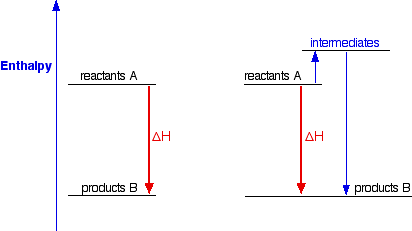
| HESS'Southward LAW AND ENTHALPY Modify CALCULATIONS This page explains Hess's Law, and uses it to exercise some uncomplicated enthalpy alter calculations involving enthalpy changes of reaction, germination and combustion. Hess's Police Stating Hess's Law Hess's Law is the most of import police force in this part of chemical science. Near calculations follow from it. It says . . . The enthalpy change accompanying a chemical change is independent of the route past which the chemical change occurs. Explaining Hess's Law Hess'due south Law is proverb that if you convert reactants A into products B, the overall enthalpy change will exist exactly the same whether you practice information technology in one stride or two steps or however many steps. If you look at the change on an enthalpy diagram, that is actually fairly obvious. This shows the enthalpy changes for an exothermic reaction using two different means of getting from reactants A to products B. In one example, you exercise a direct conversion; in the other, you employ a two-step procedure involving some intermediates. In either example, the overall enthalpy alter must exist the same, because it is governed by the relative positions of the reactants and products on the enthalpy diagram. If y'all go via the intermediates, you do accept to put in some extra heat energy to start with, but you get it back once again in the second stage of the reaction sequence. Even so many stages the reaction is done in, ultimately the overall enthalpy change will be the same, because the positions of the reactants and products on an enthalpy diagram will e'er be the aforementioned. | |||||||||
| Notation:Information technology is perhaps confusing that I am switching betwixt the terms enthalpy and energy. Enthalpy modify is only a detail measure of energy alter. You will remember that the enthalpy change is the estrus evolved or captivated during a reaction happening at abiding pressure. I have labelled the vertical scale on this item diagram as enthalpy rather than energy, because we are specifically thinking near enthalpy changes. I could accept simply kept to the more than general term "energy", merely I prefer to exist accurate. | |||||||||
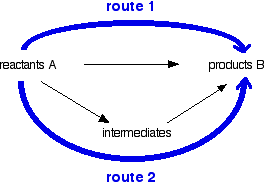
| You can do calculations by setting them out as enthalpy diagrams equally above, merely there is a much simpler way of doing it which needs virtually no thought. You could set out the above diagram as: Hess's Law says that the overall enthalpy change in these two routes will exist the same. That means that if you already know 2 of the values of enthalpy change for the iii split up reactions shown on this diagram (the 3 blackness arrows), you tin can easily calculate the third - as you will meet below. The big advantage of doing it this way is that you don't have to worry most the relative positions of everything on an enthalpy diagram. It is completely irrelevant whether a item enthalpy change is positive or negative. Warnings! Although most calculations you volition run into volition fit into a triangular diagram like the higher up, you may also come across other slightly more circuitous cases needing more steps. That doesn't make it whatever harder! Yous need to take care in choosing your two routes. The pattern volition not e'er look similar the one higher up. You will see that in the examples below. Enthalpy change calculations using Hess's Law cycles I tin can only give a brief introduction hither, because this is covered in careful, step-by-step detail in my chemistry calculations book. Working out an enthalpy change of formation from enthalpy changes of combustion If you have read an earlier page in this section, y'all may remember that I mentioned that the standard enthalpy change of formation of benzene was impossible to measure out directly. That is because carbon and hydrogen won't react to make benzene. | |||||||||
| Important:If you don't know (without thinking nearly it too much) exactly what is meant by standard enthalpy modify of germination or combustion, you must get this sorted out at present. Re-read the page about enthalpy modify definitions before you go any further - and learn them! | |||||||||
| Standard enthalpy changes of combustion, ΔH°c are relatively piece of cake to measure. For benzene, carbon and hydrogen, these are:
First you take to design your cycle.
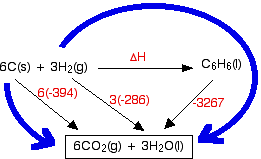
In this case, what we are trying to find is the standard enthalpy modify of formation of benzene, so that equation goes horizontally. You volition observe that I oasis't bothered to include the oxygen that the diverse things are called-for in. The corporeality of oxygen isn't critical because you just use an excess anyway, and including it really confuses the diagram. Why have I drawn a box around the carbon dioxide and h2o at the bottom of the cycle? I tend to exercise this if I can't get all the arrows to signal to exactly the right things. In this example, there is no obvious style of getting the pointer from the benzene to point at both the carbon dioxide and the h2o. Drawing the box isn't essential - I just find that it helps me to see what is going on more easily. Notice that yous may have to multiply the figures you are using. For example, standard enthalpy changes of combustion get-go with one mole of the substance you are burning. In this instance, the equations demand you to burn half dozen moles of carbon, and 3 moles of hydrogen molecules. Forgetting to do this is probably the most common mistake you are likely to make. How were the 2 routes called? Remember that yous accept to go with the flow of the arrows. Choose your starting point equally the corner that but has arrows leaving from it. Cull your cease point every bit the corner which merely has arrows arriving. At present do the adding: Hess'due south Police says that the enthalpy changes on the ii routes are the same. That means that: ΔH - 3267 = 6(-394) + iii(-286) Rearranging and solving: ΔH = 3267 + six(-394) + three(-286) ΔH = +45 kJ mol-1 | |||||||||
| Note:If you take a good retentivity, you might remember that I gave a figure of +49 kJ mol-1 for the standard enthalpy change of formation of benzene on an earlier page in this section. So why is this answer different? The primary problem here is that I have taken values of the enthalpies of combustion of hydrogen and carbon to three significant figures (ordinarily done in calculations at this level). That introduces small errors if yous are just taking each figure once. Yet, here you are multiplying the mistake in the carbon value by 6, and the error in the hydrogen value past 3. If yous are interested, y'all could rework the calculation using a value of -393.v for the carbon and -285.8 for the hydrogen. That gives an answer of +48.vi. Then why didn't I employ more accurate values in the first identify? Because I wanted to illustrate this problem! Answers yous go to questions similar this are often a fleck out. The reason commonly lies either in rounding errors (every bit in this case), or the fact that the data may have come from a different source or sources. Trying to get consistent data tin be a fleck of a nightmare. | |||||||||
| Working out an enthalpy change of reaction from enthalpy changes of formation This is the commonest use of simple Hess's Law cycles that you lot are likely to come across. In this case, we are going to calculate the enthalpy change for the reaction between ethene and hydrogen chloride gases to make chloroethane gas from the standard enthalpy of germination values in the tabular array. If you have never come across this reaction before, it makes no difference.
| |||||||||
| Note:I'k non too happy about the value for chloroethane! The information sources I normally use give a wide range of values. The one I have chosen is an average value from the NIST Chemistry WebBook. This incertitude doesn't affect how you do the calculation in whatever mode, just the reply may not exist exactly right - don't quote it every bit if information technology was right. | |||||||||
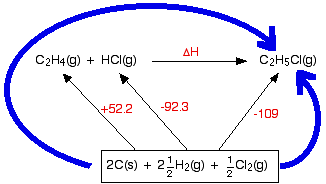
| In the cycle below, this reaction has been written horizontally, and the enthalpy of formation values added to consummate the wheel. Once again, notice the box drawn around the elements at the bottom, because it isn't possible to connect all the individual elements to the compounds they are forming in any tidy way. Exist conscientious to count upwards all the atoms you need to apply, and make sure they are written every bit they occur in the elements in their standard state. You lot mustn't, for example, write the hydrogens every bit 5H(g), because the standard state for hydrogen is H2. | |||||||||
| Annotation:In truth, if I am doing this blazon of enthalpy sum myself (with nobody watching!), I tend to merely write the word "elements" in the bottom box to save the bother of working out exactly how many of everything I need. I would be wary of doing that in an test, though. | |||||||||
| And at present the calculation. Just write downward all the enthalpy changes which make upwardly the ii routes, and equate them. +52.2 - 92.3 + ΔH = -109 Rearranging and solving: ΔH = -52.2 + 92.3 - 109 ΔH = -68.9 kJ mol-1 | |||||||||
| Note:I am afraid that this is as much as I experience I can give you on this topic without risking sales of my book, or ending upwards in breach of contract with my publishers. Unfortunately, it isn't enough for you to be confident of being able to do these calculations every time. Apart from annihilation else, you lot need lots of practice. I have talked this through more gently in the book, with lots of examples. If you lot chose to work through chapter 5 in the book, you would be confident that you could do whatsoever chemical energetics calculation that yous were given. Obviously I'm biased, merely I strongly recommend that you either buy the book, or get hold of a copy from your school or college or local library. Don't just take my word for information technology - read the reviews on the Amazon website | |||||||||
| Questions to exam your agreement If this is the first set of questions yous have done, please read the introductory page before you beginning. You will need to use the Dorsum Push button on your browser to come back here later on. questions on Hess's Police force answers
To the chemical energetics menu . . . To the Physical Chemical science menu . . . To Chief Menu . . . © Jim Clark 2022 (modified May 2022) | |||||||||
 .
.

Source: https://www.chemguide.co.uk/physical/energetics/sums.html
Posted by: balesdeally70.blogspot.com
0 Response to "How To Draw An Enthalpy Diagram"
Post a Comment